UX Master's thesis — ESD Toulouse
From Board Game to Prototype
A card game kit that makes prototyping workshops more engaging
- Role
- Research, game design, kit design, writing, website design & development
- Timeline
- 2025 — 2026
- Format
- Final-year project (M2)
- Tools
- Figma, Astro, Three.js, Netlify
At a glance
- The problem
- In public-sector co-design workshops, non-designer staff don't feel entitled to produce: fear of judgment, unfamiliar design conventions, trouble moving from idea to concrete output.
- The outcome
- An 88-card kit, a facilitator's guide, a white paper and an online version, tested in a pilot workshop with six managers: 22 downloads and 8 games played since launch.
- 22kit downloads since launch
- 8games played on the online version
- 88cards designed, across 5 families
Context and problem
Master's thesis in UX Design at ESD Toulouse, run as action research during my apprenticeship at Urssaf Midi-Pyrénées. Starting point: board game mechanics — roles, turns, cards, goals — form a powerful facilitation framework that public-sector design workshops rarely exploit.
Four barriers recur in public-sector co-design workshops: fear of judgment, difficulty moving from idea to concrete output, design conventions that feel foreign to non-designers, and role boundaries that discourage speaking outside one's remit. All converge on the same point: creative self-efficacy too low for participants to feel entitled to produce.
Research methodology
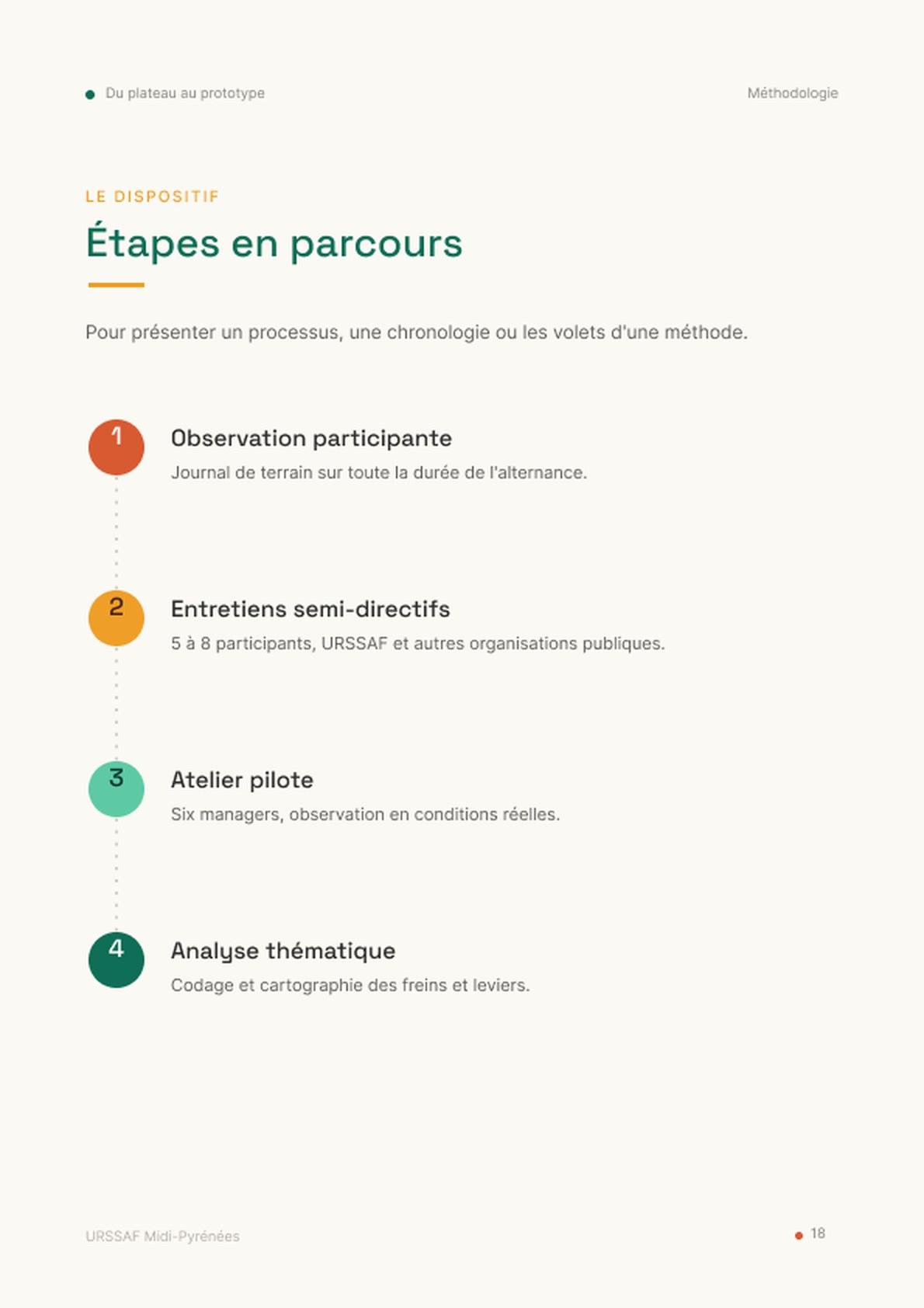
Participant observation, with a field journal
With whom
Workshops at Urssaf, throughout my apprenticeship
What it revealed
What actually happens in a workshop, who speaks, when the group disengages: a few profiles dominate the workshop while the others stay silent.
Semi-structured interviews and thematic analysis
With whom
Five to eight participants, at Urssaf and in other public organisations
What it revealed
Four barriers recur: fear of judgment, difficulty moving from idea to concrete output, design conventions foreign to non-designers, and role boundaries. Coding produced a barriers-to-levers table, each barrier set against the game mechanic able to neutralise it: that table drove the design of the kit.
Pilot workshop, observed from start to finish
With whom
Six managers, in real conditions
What it revealed
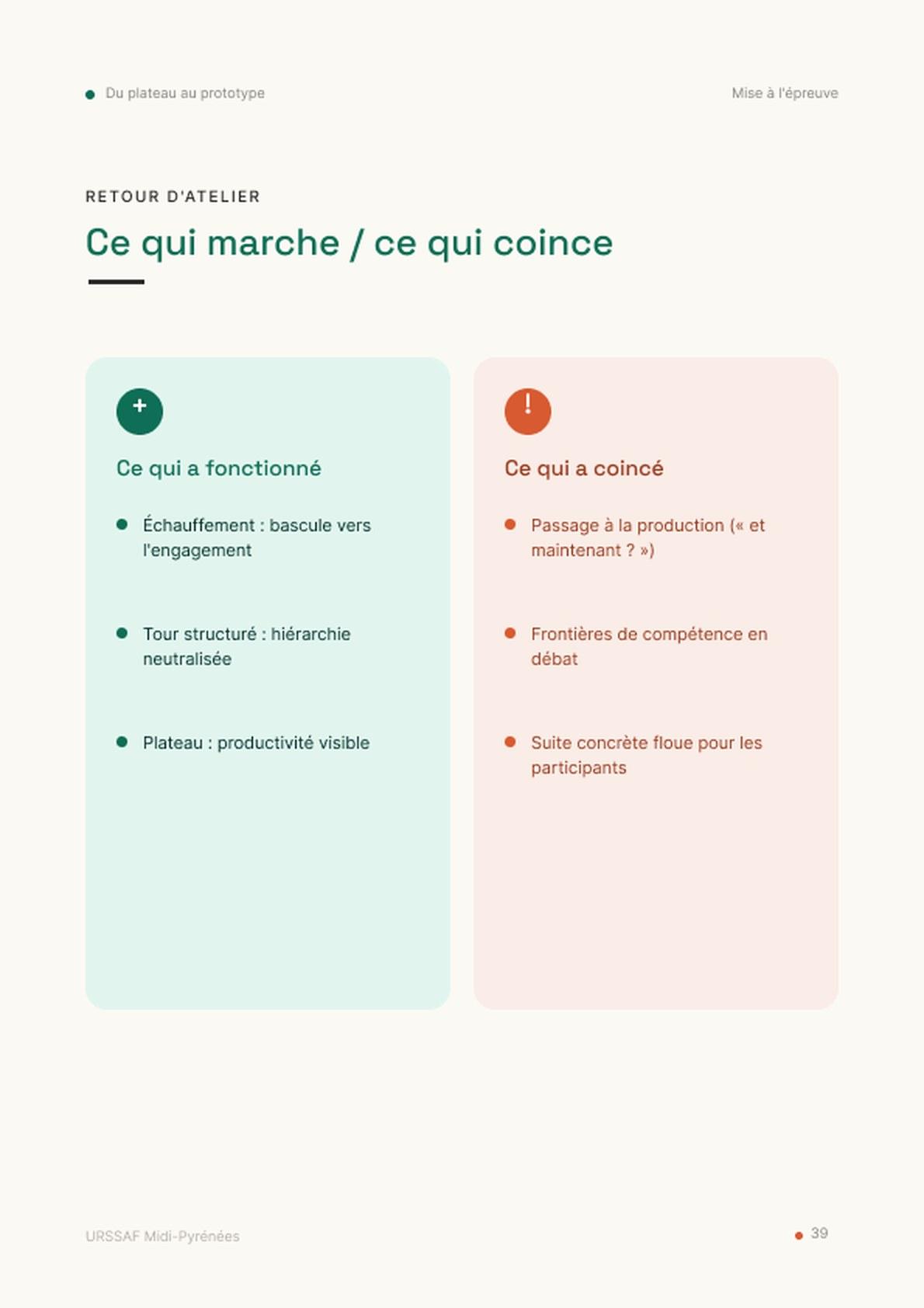
Three effects confirmed: the warm-up tips the group into engagement, the card-driven structured round neutralises hierarchy, and the board makes output visible to everyone. The weak point: the hand-off to production.
User needs
As a non-designer staff member, I want to contribute without mastering design conventions or fearing my colleagues' judgment.
As a in-house facilitator, I want a ready-made structure that keeps the pace for me, so I can facilitate without having to arbitrate.
As a workshop sponsor, I want to leave with formalised ideas and a named owner, not just a good atmosphere.
Iterations
After the pilot
The "From board to backlog" chapter
What changed
Added the "From board to backlog" chapter to the facilitator's guide.
Why
In the pilot, the hand-off to production broke down ("so what now?"): role boundaries got renegotiated during the session, and the concrete follow-up stayed unclear to participants.
Trade-offs
I chose
A static Astro site, zero-JS by default, with no account or backend
over
A heavier stack
because
The kit can be tried in one click with no sign-up friction, and a fast static site serves the content better: technical restraint serves adoption.
Final solution
A complete facilitation tool, from print to digital: any team can download the kit, print the cards and run a structured prototyping workshop — or play it directly online.
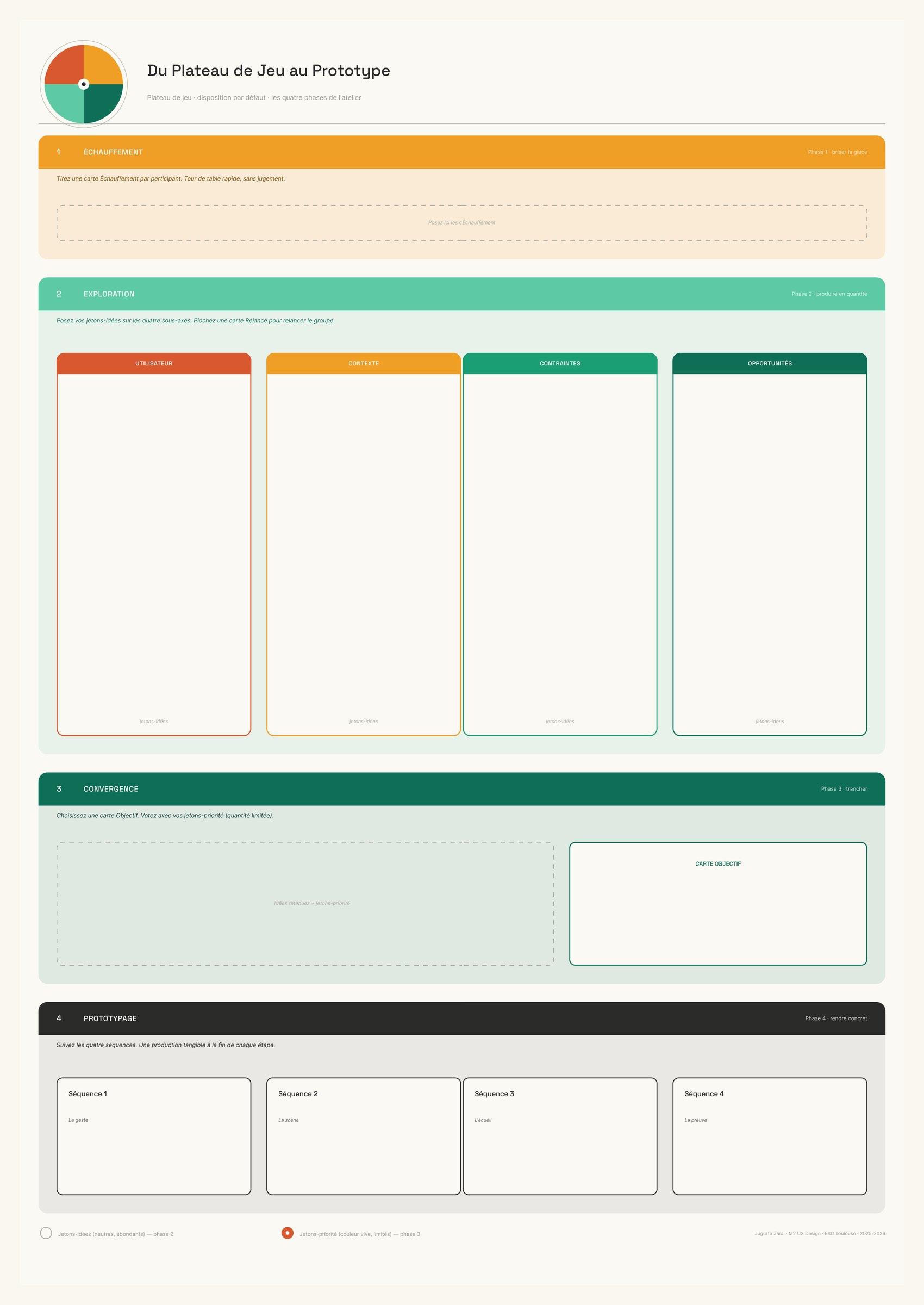
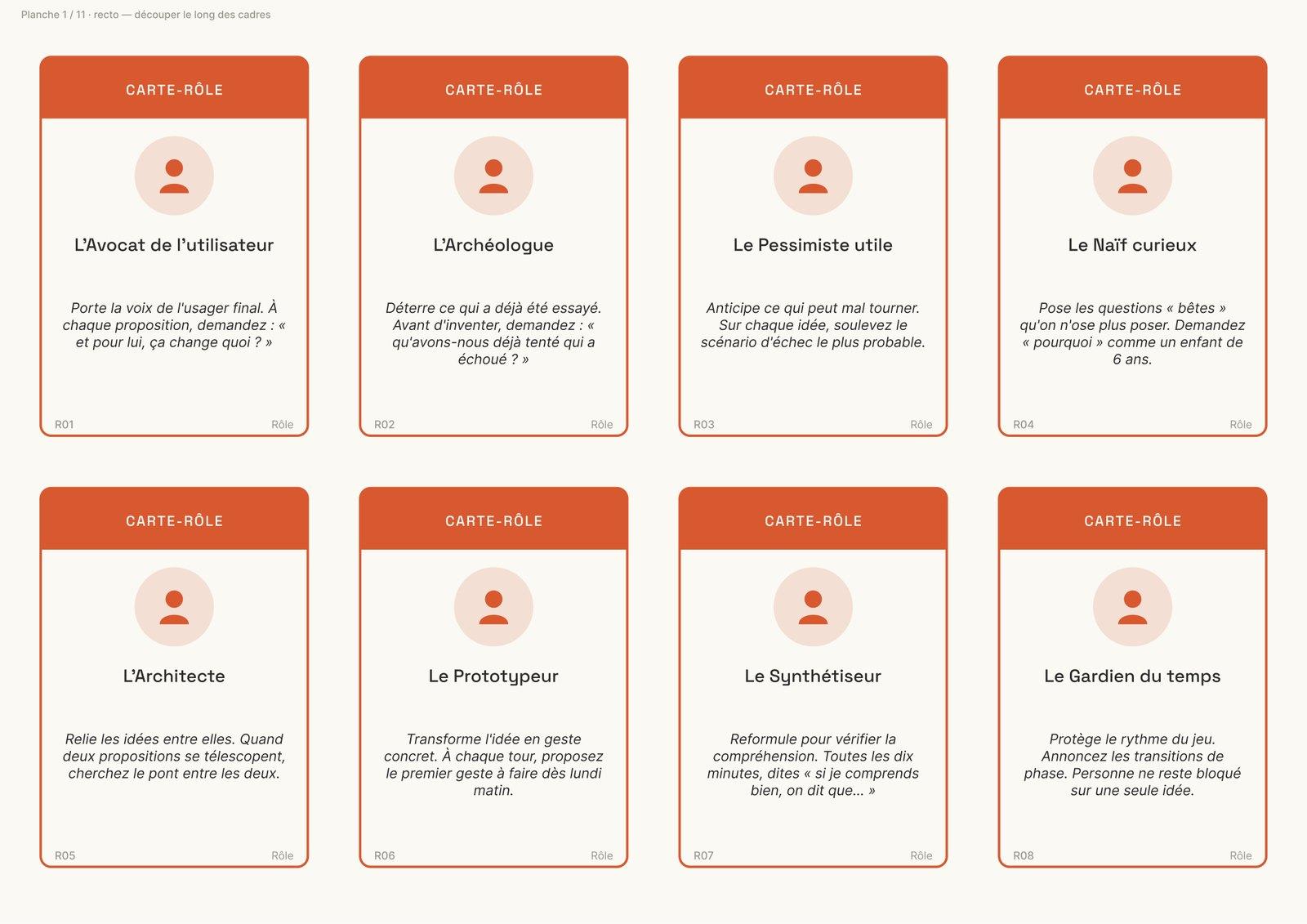
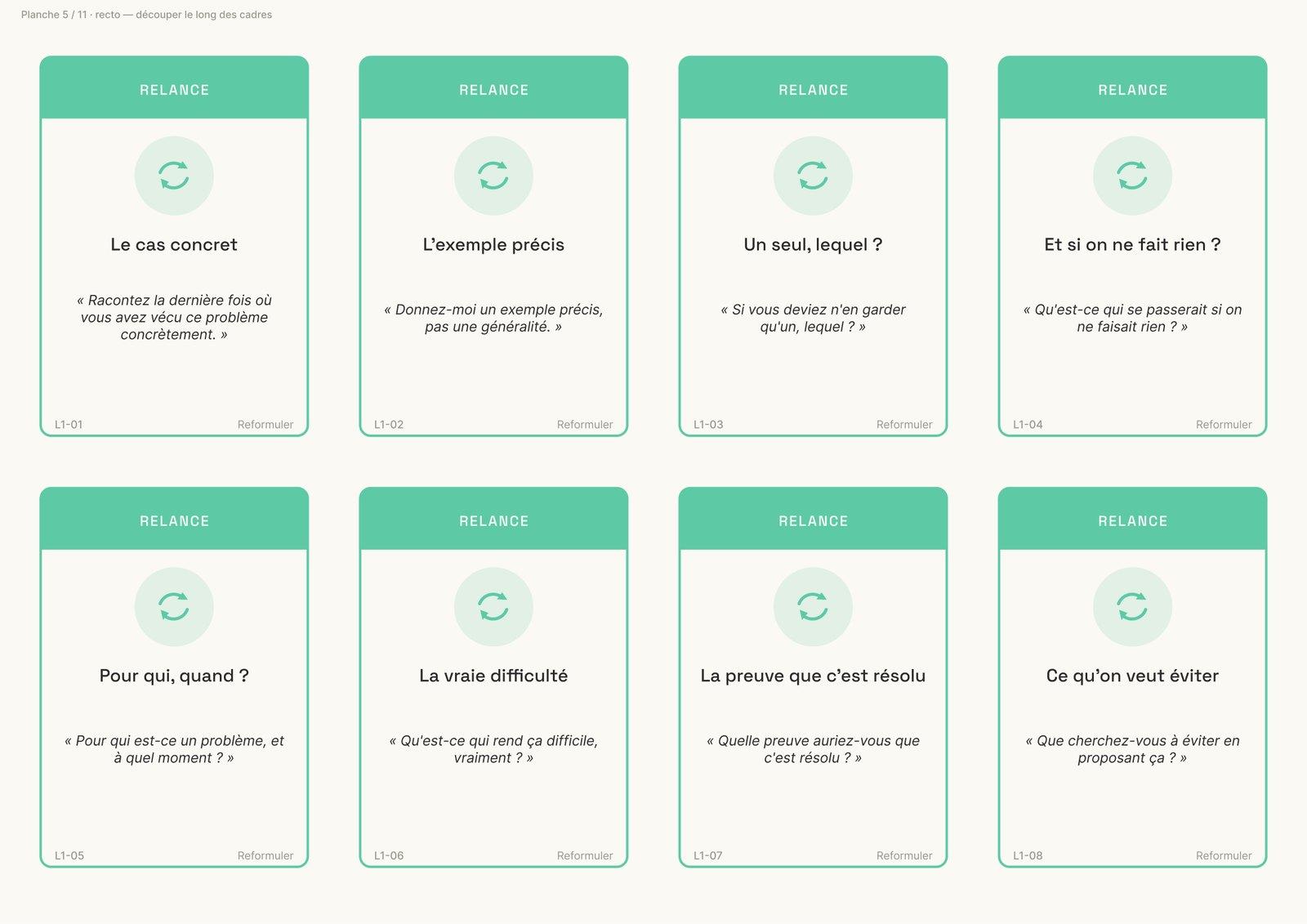
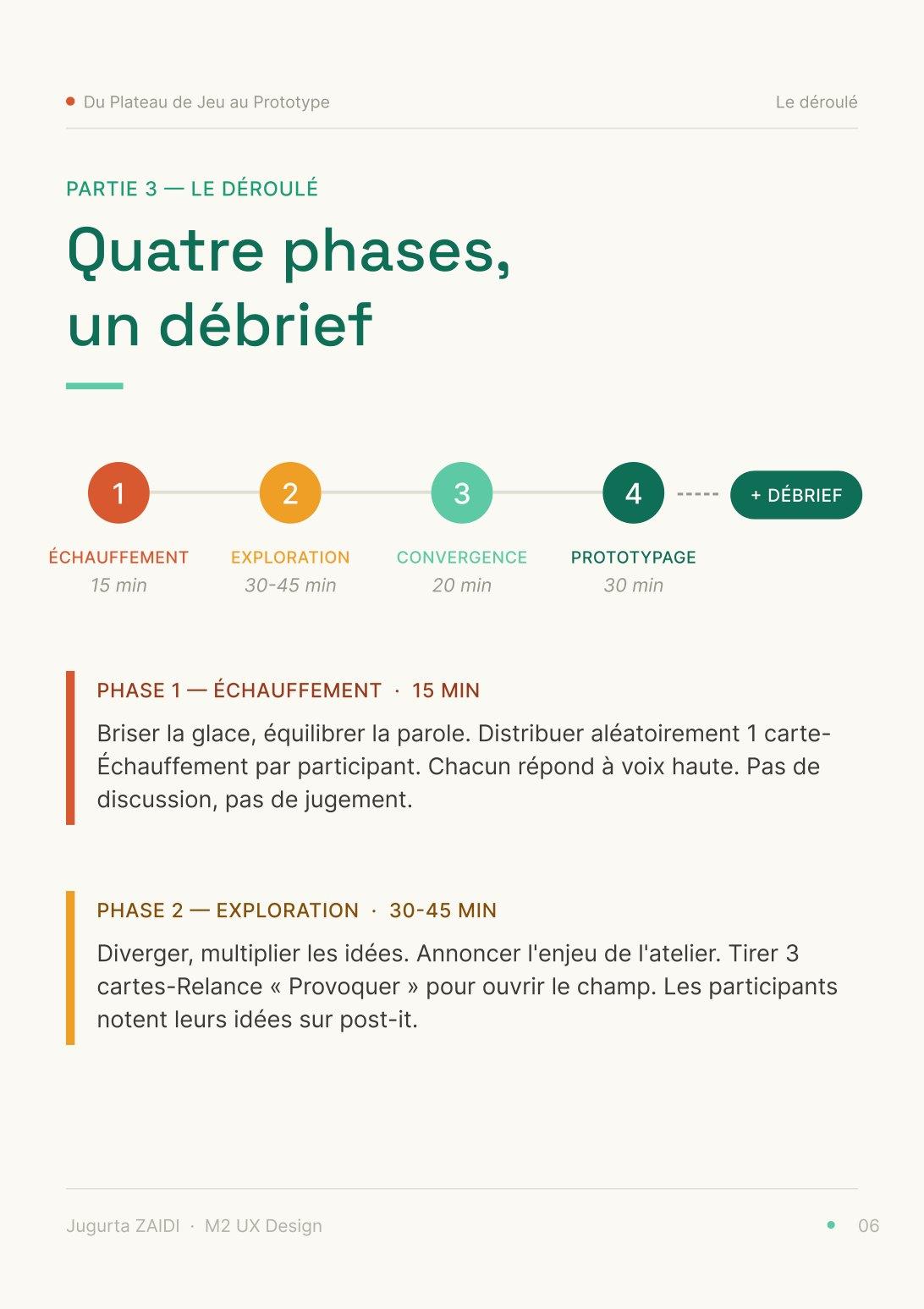
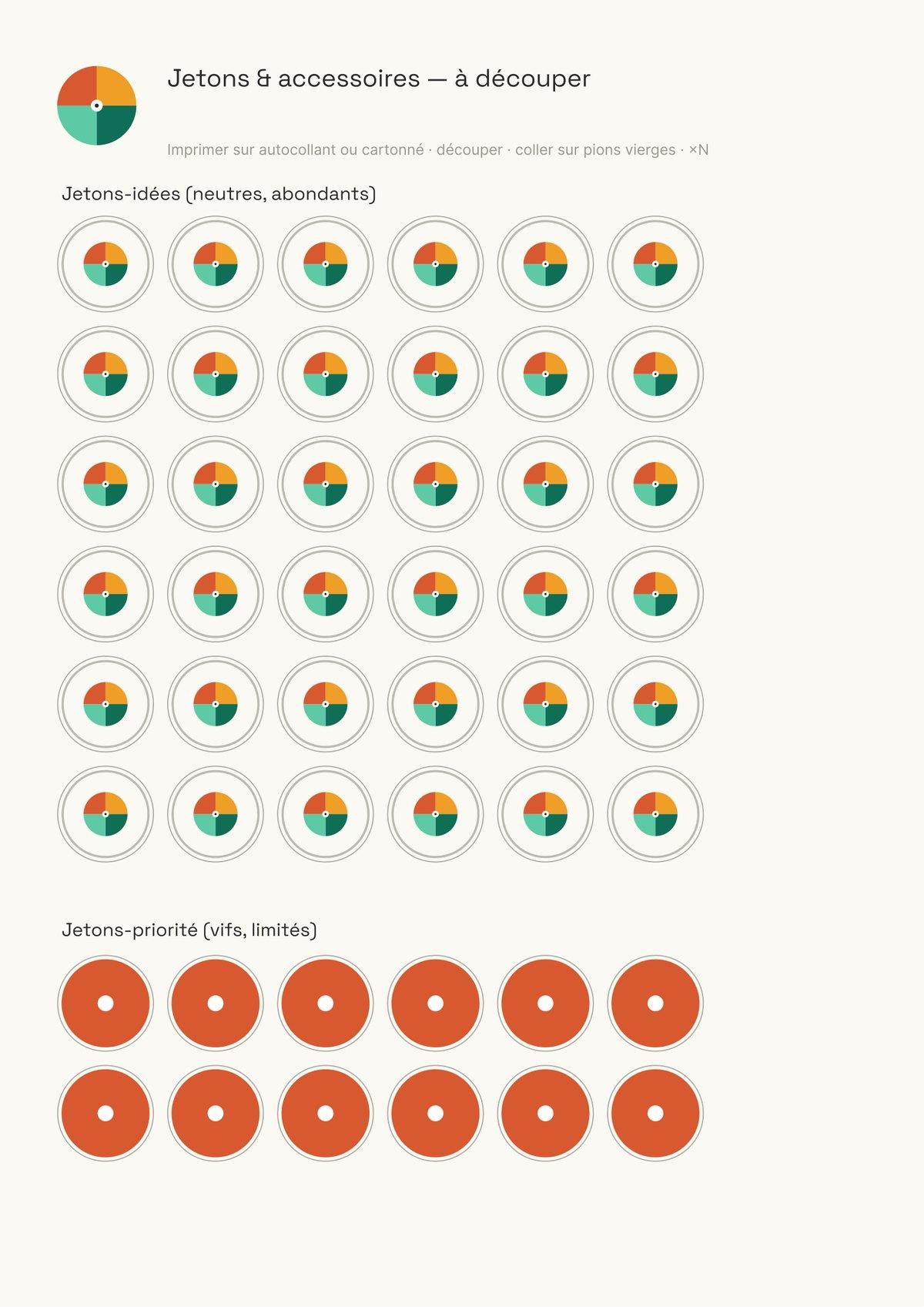
88 cards structuring the workshop in 4 phases
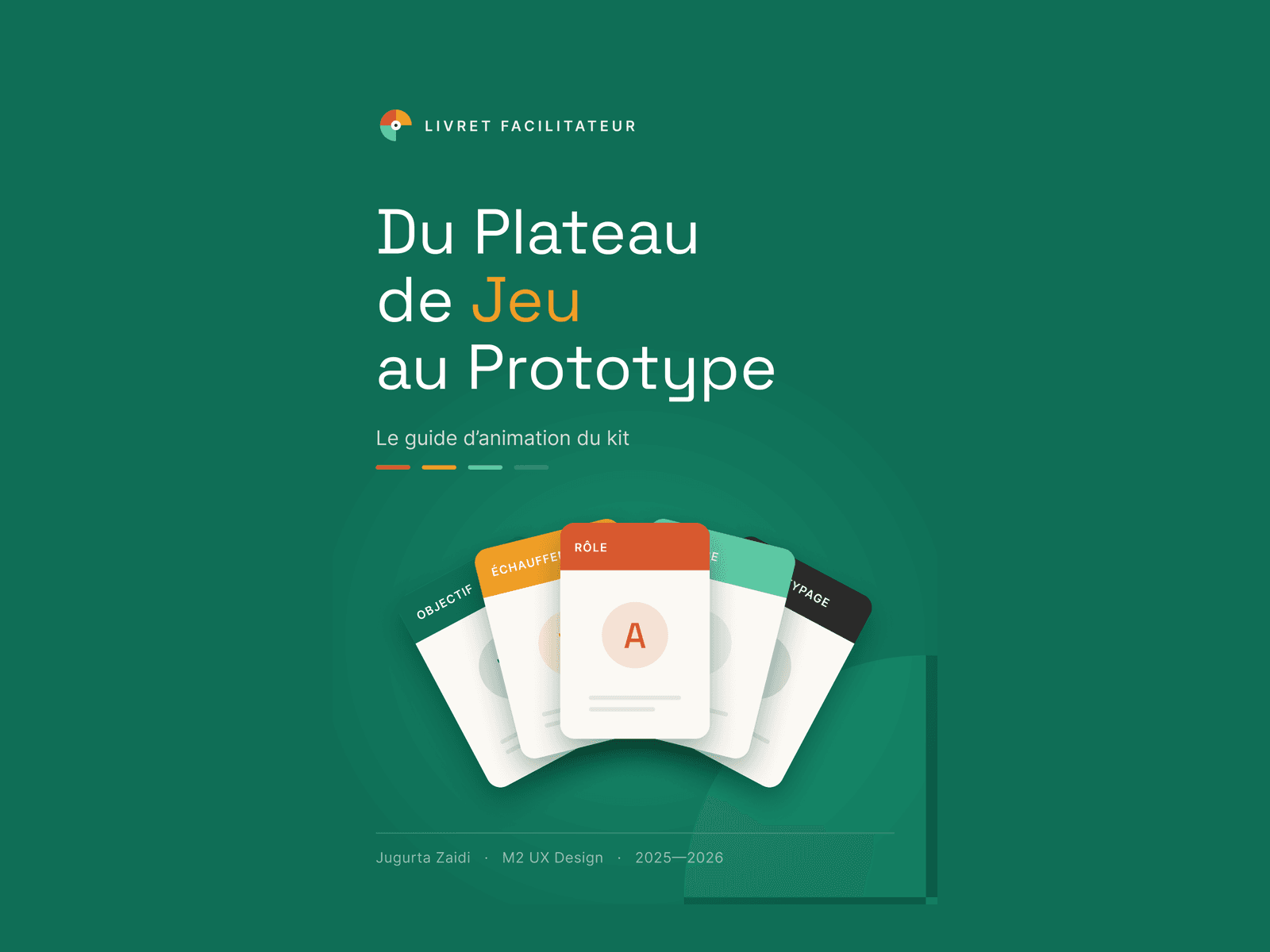
8 roles, 24 warm-ups, 40 creative prompts, 12 goals, 4 prototyping cards. The system imposes a flow — from warm-up to synthesis — without the facilitator having to invent it.
Role cards rebalance participation
Assigning an explicit role to each participant neutralizes the core problem identified: a few profiles dominate the workshop while others stay silent. The playful frame legitimizes speaking up.
A facilitator's guide to run it with zero prep
12 pages that make the tool transferable: anyone can run the workshop without having read the thesis. That's the condition for research to serve beyond its author.
A playable online version, no account or backend
Zero-JS-by-default Astro site: the kit can be tried in one click, with no sign-up friction. Technical restraint is a design choice serving adoption.
Deliverables
- 88cards designed, across 5 families
- 4workshop phases, from warm-up to prototype
- 67pages of white paper
- 3deliverables published in open access
- 6managers in the pilot workshop
Measured outcomes
- 22
- kit downloads since launch
- Measured by · the site's download form, running since launch
- 8
- games played on the online version
- Measured by · the site's counters, running since launch
Research turned into a reusable tool
The thesis doesn't stop at the white paper: it produces a printable kit, a facilitator's guide and an online version any team can adopt without reading the research. All released under a Creative Commons BY-NC-SA licence.
What I learned
- Turning academic research into an actionable tool: a thesis only matters if someone can use it.
- Designing for print and digital at the same time forces you into a coherent design system.
- Technical restraint is a design choice: a fast static site serves the content better than a heavy stack.
- A successful workshop is not enough: without an owner designated before the session to pick the ideas back up the next day, the output evaporates. That was the pilot's clearest finding.